
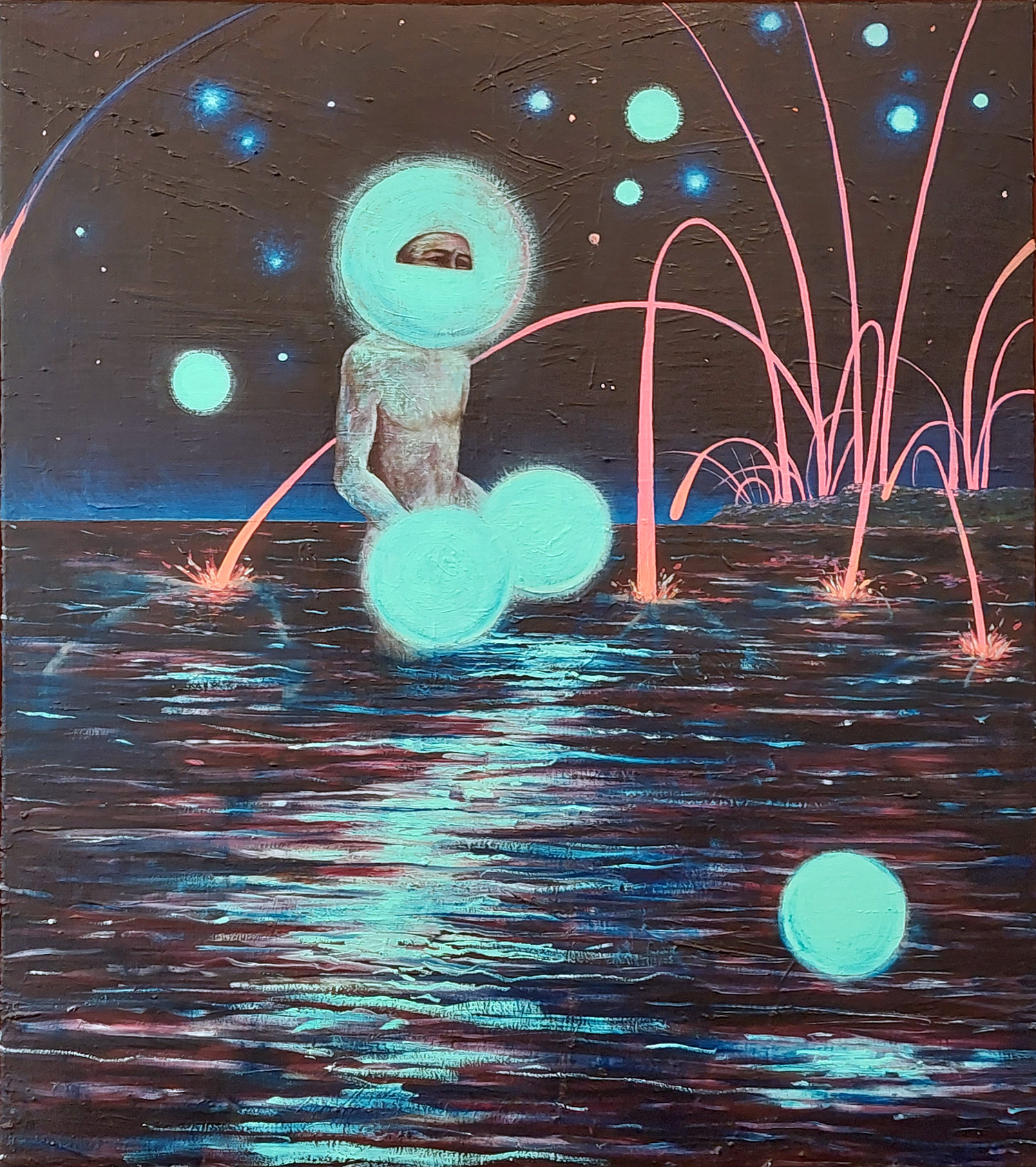
Kerstin Junker „Zaklinacz” („Der Verzauberer”), olej na płótnie, 2017. Galerie Holger John. Drezno 2022
„Jednym ruchem kończyn amfibia zostawiała w tyle kilometr spienionej bruzdy. Przez mgnienie oka, gdy wyciągnięte ku przodowi ramię wisi w powietrzu przed następnym zanurzeniem, rozstawione palce tego stwora ziemnowodnego, połączone fałdą skóry mającej postać błony, zdawały się wnosić ku wyżynom przestrzeni, aby chwytać gwiazdy. Stojąc na skale, użyłem mych dłoni jako tuby i zawołałem takim głosem, że kraby i raki uciekły w mrok najgłębszych szczelin: ‘O ty, który poruszasz się w wodzie ze swobodą przewyższającą lot długich skrzydeł fregaty, jeżeli rozumiesz jeszcze znaczenie donośnych falowań głosu, który ludzkość wydaje silnymi rzutami jako wiernego tłumacza swych najtajniejszych myśli, zechciej powstrzymać twą szybką żeglugę, aby opowiedzieć mi zwięźle i prawdziwie główne wydarzenia twej historii. Ale, uprzedzam, możesz się nie odzywać, o ile śmiałym twoim zamiarem jest wzbudzić we mnie przyjaźń i uwielbienie, które poczułem już w pierwszej chwili, gdy cię zobaczyłem odbywającego z wdziękiem i siłą rekina tę pielgrzymkę nieposkromioną i prostolinijną.’
W odpowiedzi zabrzmiało westchnienie, od którego zlodowaciały mi kości i zachwiał się głaz pod moimi stopami (a może ja sam, ugodzony potężnym ciosem fal dźwiękowych, przynoszących mi taki krzyk rozpaczy); było je słychać nawet we wnętrznościach ziemi, a ryby ukryły się pod falami z łoskotem lawiny. Pływak nie miał odwagi dotrzeć do samego brzegu, lecz gdy się upewnił, że mój organ słuchu dość wyraźnie chwyta jego słowa, zwolnił ruchy swych płetwiastych odnóży, utrzymując tors, pokryty trawą morską, nad powierzchnią ryczących fal. Schylił czoło, jak gdyby uroczystym rozkazem przyzywał błędną sforę wspomnień. Nie śmiałem przerywać mu tego zajęcia dostojnie archeologicznego – pogrążony w przeszłości, był podobny do skały. Na koniec przemówił tymi słowy: (…)
‘Odkąd rzuciłem dom rodzinny, nie ubolewam już tak bardzo, jak mógłbyś sądzić, nad tym, że mieszkam na morzu i w jego kryształowych grotach. Opatrzność, jak widzisz, dała mi po części organizm łabędzia. Żyję spokojnie wśród ryb i one, niczym swojemu władcy, dostarczają mi pożywienia, którego potrzebuję. Przywołam je zaraz szczególnym gwizdnięciem, o ile ci to nie przeszkadza, i zobaczysz ich przybycie.’ Stało się, jak powiedział. Podjął znowu swoją królewską żeglugę w orszaku poddanych. I chociaż po kilku minutach całkowicie zniknął mi z oczu, mając perspektywę mogłem go jeszcze widzieć przy samej linii horyzontu”.
Comte de Lautréamont Pieśni Maldorora i Poezje (1869), przeł. Maciej Żurowski (1976)
“In a single stroke, the amphibian left a foamy wake one kilometre long behind him. In the brief instant when his forward-straining arm remains suspended in the air before plunging down again, his fingers, outspread and joined together by a fold of skin in the form of membrane, seemed to be soaring up towards the heights of space and grasping the stars. Standing on the rocks, I used my hands as a speaking-trumpet and exclaimed, while crabs and crayfish fled into the darkness of the most secret crevices: ‘Oh you who swim faster than the winged frigate in its flight, if you still understand the meaning of these loud sounds which mankind utters as the faithful translation of its inner thoughts, deign for a moment to halt your swift movements and tell me briefly the phases of your true story. But I warn you that you do not need to address me at all, if your bold design be to arouse in me that feeling of friendship and reverence which I felt for you the moment I saw you for the first time moving through the waves with the grace and the strength of a shark on your indomitable and rectilinear pilgrimage.’
A sigh, which made me shudder to the bone and made the rock on which the soles of my feet rested stagger (unless it was I who staggered, violently pierced by the sound-waves which brought such a cry of despair to my ears), could be heard even in the bowels of the earth; the fish dived beneath the waves with noise of an avalanche. The amphibian did not dare approach too close to the shore; but as soon as he had ascertained that his voice reached my eardrum distinctly enough, he slowed down the movement of his palmate limbs and lifted his wrack-covered head up from the roaring waves. I saw him bow his head, as if, by a solemn command, to summon the wandering pack of memories. I did not dare interrupt him in this holy and archaeological occupation; absorbed in the past, he looked like a rock. At last he spoke, as follows: (…)
‘Since the day I fled from my father’s house, I have not had as much reason as you might think to complain of my life in the sea with its crystal grottoes. Providence, as you see, has given me in part the nature of a swan. I live in peace with the fish and they provide me with all the food I need as if I were their monarch. I shall whistle in a special way so as not to set your teeth on edge, and you will see them all reappear.’ It happened just as he had predicted. He went on swimming regally, surrounded by his train of loyal subjects. And though after a few seconds he had completely disappeared from sight, using a telescope I could still see him on the furthest limits of the horizon”.
Comte de Lautréamont Maldoror and poems (1869). Translated by Paul Knight (1978)
 W miasto