
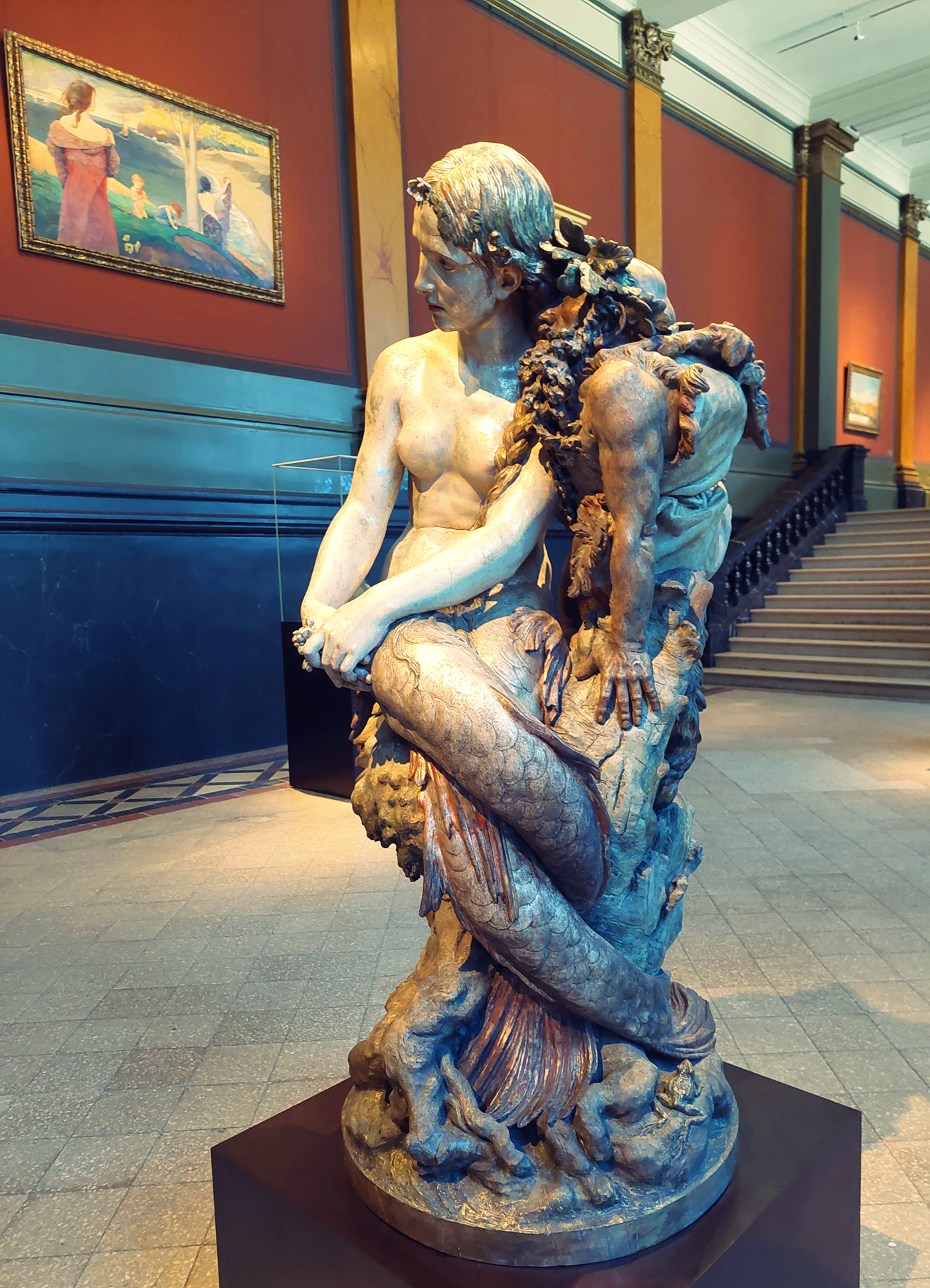
Robert Diez „Tajemnica lasu” („Waldgeheimnis”), 1884, wyrzeźbiona w drewnie lipowym, oczy wykonane z kryształu górskiego. Albertinum. Drezno 2022
Pokrętnym mięśniem smoczego ogona
Wciąż biła kąpiel na pył diamentowy
Aż ciężkiej wody mgiełka roztańczona
Złamała światło w powietrzu matowym.
Jej Pan znał dobrze śnieżnopiękne ciało
Wzór żyłek sinych pod skórą jej białą
Lecz w srebrnej łusce nie dostrzegł urody
Ani w błękitnej płetwie w bryzgach wody…
A.S. Byatt Opętanie (1990), przeł. Barbara Kopeć-Umiastowska (1998)
“In 1941 the founder of the Surrealist art movement, André Breton (1896-1966), fled from France to New York. Here he met the artist Elisa Bindhoff (1906-2000) who would become his third wife. In the summer of 1944 they stayed on the Gaspé Peninsula in northeast Canada and during their three months there Breton wrote Arcane 17, an extended prose poem named after the 17th card – The Star – in the tarot’s Major Arcana. The work combined the personal with the mythical and reflected upon themes of love, loss and war, pertinent for Breton, who, like his new wife, had recently experienced profound personal misfortune. The Star symbolised hope and renewal. By associating this card with the medieval figure of the faery-siren Mélusine, Breton found an image through which he could channel his thoughts about everything from alchemy and politics to the future of humanity. (…)
Thematically, Arcane 17 considered loss, redemption, and love. The winged mermaid-serpent, Melusine, hovered over these, lending her presence to Breton’s pen as he struggled to make sense of the brutality of war, personal relationships and the cycles of nature. (…) Ultimately, Elisa/Melusine in her siren aspect is the guide through this darkness, from death to new life, the alchemical mermaid integrating oppositions and through this, allowing her energies to infiltrate the present. The Star card is both access point and map, a means of illuminating the emotional landscape and providing a way by which Breton’s poetically inclined sensibility might yet find meaning in the destruction and personal upheaval of the times, emerging renewed. This re-enchantment of a world gone sour draws upon the abstract realms of myth and occultism but it takes root in the physical world. There is a moment when Breton breaks his active meditations. ‘A gap in the dream’, he notes, ‘Are we saying that nothing is ever found again?’ (1994: 84). But in many respects, he had already found it, in writing Arcane 17, in his relationship with Elisa, and in the landscape around the immense Percé Rock on the coast of Quebec”.
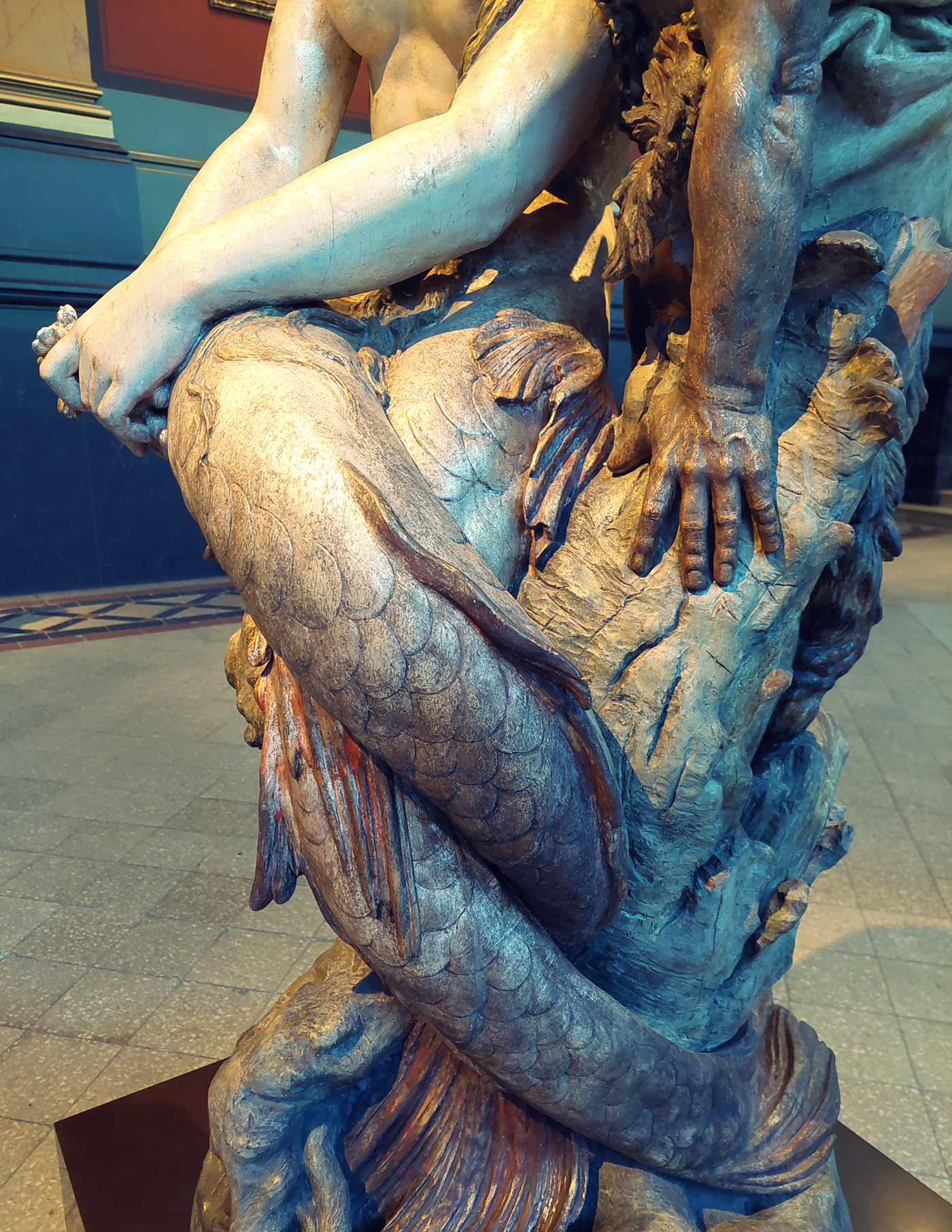
“The discovery of her by a water source in a forest and beneath a full moon is a clear indication to the reader of her supernatural connections, setting up the expectation of what will follow later on. Raymondin, so taken by her beauty and her amiable manners, falls in love, and Melusine agrees to marry him but with one condition: that he make no attempt to see her on Saturday, when she will go into seclusion. Melusine transforms the fortunes of the impoverished Raymondin and the region of Poitou. Forests are cleared and crops planted; castles and other fortresses are built, fountains and springs nourish the land (Kelly, 1996). This all happens with great speed and seemingly little effort. The fertility of the land is matched by her own. (…) After seven years Raymondin breaks his vow. He spies on Melusine in her chamber and sees her bathing, the lower part of her body transformed into a serpentine tail. It is only when he reveals his discovery to others, however, that Melusine utters ‘a very doleful cry and then a heavy sigh’ before leaping ‘from the window into the void’ and metamorphosing into ‘a massive dragon some fifteen feet in length’”.
Alex Woodcock Melusine As Alchemical Siren In André Breton’s Arcane 17 (1945) (2018)

“Bindorff assumes all the roles of surrealist Woman: the muse, the femme fatale, the child-woman, but also the ‘femme-voyant’ or seer, ‘femme-fée’ or fairy, and ‘femme-sorcière,’ the witch or sorceress. Where more generic spiritual themes, such as clairvoyance and predestination, can be found in Nadja and Mad Love, the occult side of woman and her magical powers are much more prominent in A17, even emphatically so. Deeply convinced that the ideas of man had led to the war, Breton proclaimed those of womankind to be the only alternative:
The time has come to value the ideas of woman at the expense of those of man, whose bankruptcy is coming to pass fairly tumultuously today. It is artists, in particular, who must take the responsibility, […] to maximise the importance of everything that stands out in the feminine worldview in contrast to the masculine […] (…)
The three major characters in A17 are the fairy Melusina, the Egyptian goddess Isis and the figure of the Star, the tarot’s seventeenth ‘arcanum’ or seventeenth card of the Major Arcana. Melusina, to start with, is a hybrid fey creature who every Saturday turns into a serpent or fish below the waist, according to the legend as told by French court writer Jean d’Arras in 1392. She exemplifies the woman as Other: while she may look like a woman, she is, in fact, Nature embodied, an undine or elemental spirit of water. She is the enticing woman whom man cannot do without but of whose secretive mysterious powers he will ever remain in awe of. Breton may have picked up Melusina from nineteenth-century German and French literature; for instance, from Zola’s novel Nana (1880). In contrast to Zola’s demonic and destructive Melusina-figure, however, Breton’s Melusina is a good fairy: innocent, beautiful and forever young, a child-woman. Breton further inverts the traditional ending of the tale by allowing Melusina ‒ usually exiled to the fay realm ‒ to be healed, redeemed and active in the human world”.
Tessel M. Bauduin Surrealism and the Occult. Occultism and Western Esotericism in the Work and Movement of André Breton (2014)
 W miasto